2.02
Wolf burner that clicks but will not light, in Nocatee kitchens
2.2.1 What the clicking tells you
The click is the spark module doing its job. It means the control has power, the switch under the knob has closed, and the module is firing an electrode. So a clicking burner that will not light has already ruled out several things. What remains is gas, geometry, or spark quality.
On most sealed-burner designs the module fires more than one electrode at a time, so hearing clicks from a neighbouring burner is normal and is not a fault in itself. What matters is whether the burner you turned on produces a flame within a few seconds.
2.2.2 Gas at the burner
We start upstream. The range or rangetop has a shutoff behind or below it, and in new St. Johns County houses that valve is often untouched since the installer left. A valve that is partly closed, or a flexible connector kinked against the wall when the appliance was pushed back, starves every burner at once and shows up first on the smallest one.
If the house runs on liquid propane rather than piped gas, we confirm the appliance is set up for the fuel it is actually being fed. Orifices and the pressure regulator are fuel-specific. An appliance running on the wrong set will either flood with yellow, lifting flame or refuse to sustain a low simmer.
2.2.3 Cap seating and blocked ports
More single-burner calls come down to the cap than to anything electrical. The cap has to sit square on the base with its ports clear. After a wash, a cap put back a few degrees out of position leaves the ignition port away from the electrode, and the burner will spark all day without catching.
Ports block from the inside as well. A boil-over runs down into the burner and bakes there, and what dries in a port is a hard crust rather than the soft residue on the surface around it — it will not wipe off, and a burner with two or three ports blocked lights unevenly or sparks without catching at all. We clear ports mechanically with a fine wire, never by drilling, which permanently changes the port size and the flame with it.
2.2.4 Spark quality and moisture
An electrode delivers spark through a ceramic insulator. Crack that insulator, or bridge it with grease or cleaning fluid, and the spark tracks to the nearest metal instead of jumping the gap to the burner. The click sounds identical; the flame never arrives.
Water is the common version of this in a Florida kitchen. A rangetop cleaned with a wet cloth on a humid afternoon can stay damp inside the burner well for an hour. When a customer tells us the burner failed right after a deep clean and then recovered on its own overnight, that is the whole diagnosis.
2.2.5 One burner versus all of them
The split matters, so we ask it on the phone.
One burner out, the rest normal, points at that burner: cap, port, electrode, or the wire back to the module. Every burner out points at supply gas, the module itself, or the power feed to the appliance. Every burner clicking continuously even with all knobs off usually means a switch is stuck closed or a knob shaft has been pushed in and not released.
2.2.6 Simmer that will not hold
A burner that lights on high and drops out at the low setting is a different fault from one that never lights. It is normally a regulator or valve issue, or a burner that has been reassembled with the simmer plate or cap from a different position on the same appliance. Sealed burners are not always interchangeable across positions, and swapping two caps during cleaning is easy to do and easy to miss.
2.2.7 What the visit involves
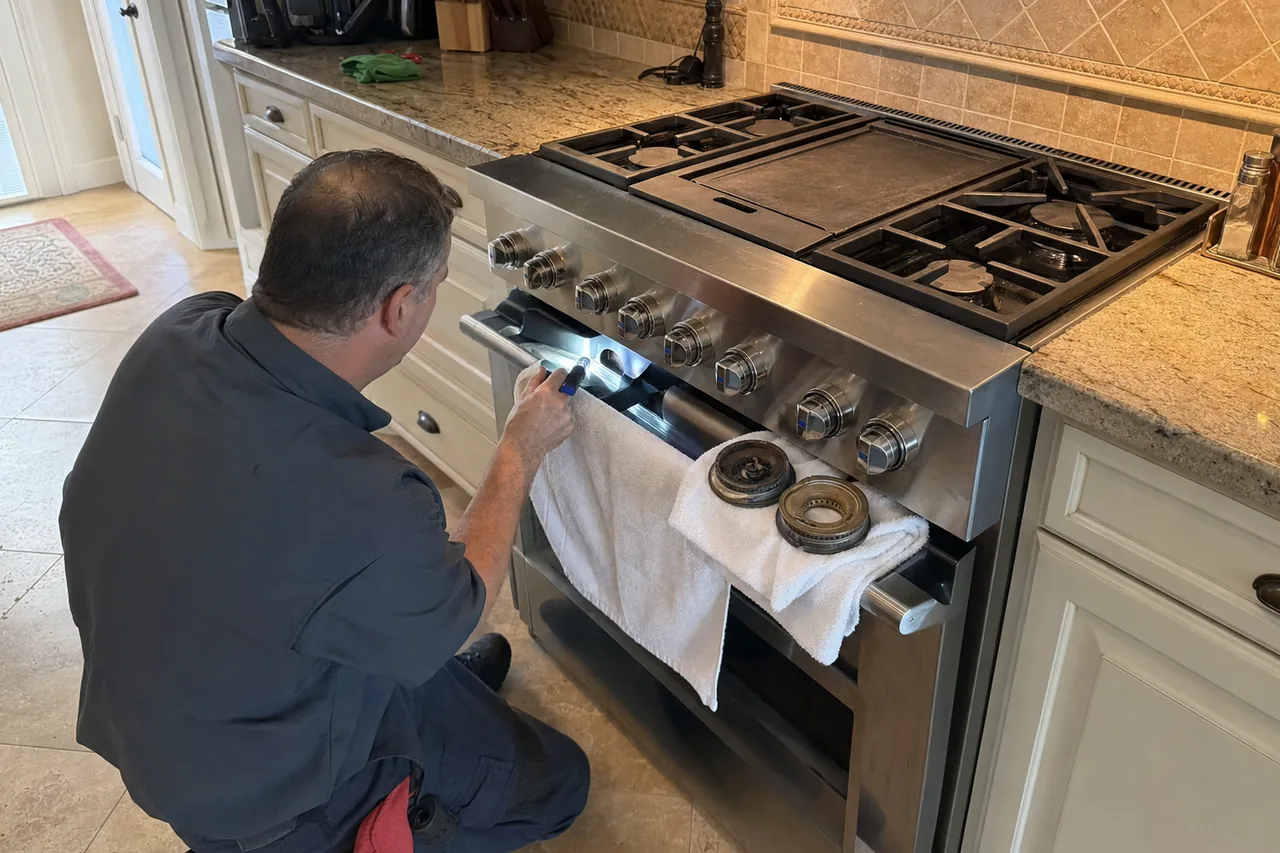
We test for gas at the appliance, check manifold pressure where the connection allows it, inspect every cap and port, measure the spark gap and the module output, and run each burner through its full range from full flame to the lowest simmer the appliance is designed to hold. You get a written estimate before any part is fitted, and the flat diagnostic is credited toward the repair once you approve the work.
We work on Wolf cooking equipment only.
What does this repair cost in Nocatee?
$80 flat to come out and find the fault, credited in full against the repair when you approve it. Beyond that, the work below is what these jobs run to once parts and labour are counted — $80 at the low end, $1,070 at the top of the widest band on this page.
| No. | Work | Completed, parts and labour |
|---|---|---|
| 2.02.6.01 | Flat diagnostic fee | $80 |
| 2.02.6.02 | Burner valve or orifice service | $230–$660 |
| 2.02.6.03 | Igniter or spark module replacement | $190–$550 |
| 2.02.6.04 | Oven thermostat or temperature sensor | $180–$520 |
| 2.02.6.05 | Control board or touch panel | $460–$1,070 |
A range, because the firm figure is written down after the diagnosis and not before it. The band a job lands in depends on which part failed, whether the appliance has to come out of the cabinetry to reach it, and what the part costs the week it is ordered. A written estimate is provided before any repair begins. No work starts without your approval.
Questions about wolf burner clicks, no flame
- Why does one burner click without lighting while the others are fine?
- A single dead burner is almost always local to that burner. The cap is sitting a few degrees out of square after a wash, a port has a baked boil-over in it, the electrode ceramic is cracked, or the wire back to the spark module has come off. The neighbouring burners share none of those parts.
- Is it safe to keep using the range while one burner will not light?
- Gas is leaving the port for as long as that knob is open, so turn it off and use another burner. If you can smell gas with every knob closed, shut the valve behind the appliance and call the gas utility before you call us. A burner that only refuses to catch is not urgent; a smell is.
Cross-index
2.02.8.1Other repair entries
- 2.01Wolf oven not heating, or driftingWall oven, Range
- 2.03Wolf induction drops outCooktop, Range
- 2.06Wolf hood noisy or weakVentilation hood
- 2.07Wolf grill heats unevenlyOutdoor grill
2.02.8.2Reference
- 4.01Storms and boardsPower and storms
- 4.02Access and clearanceInstallation
- 4.03Maintenance calendarMaintenance
- 4.04Power, gas, openingsInstallation
- 4.05Parts and lead timesParts
- 4.06GlossaryGlossary
2.02.8.3Where we are called out
- 3.01Twenty Mile32081 · Nocatee village
- 3.02Coastal Oaks32081 · Nocatee village
- 3.06Crosswater32081 · Nocatee village
What owners said after this repair
4.5 out of 5, from 63 published entries. Each is one visit, in the words of the person who paid for it.
Our simmer burner lit with a small pop and then went out. He found the cap seated wrong and half the ports carboned up from a sauce that had boiled over months ago. He cleaned it and reseated it properly.
Julian M.
The flames were yellow and lifting on the two rear positions. He checked the air shutters, found lint from the new build still packed in behind the burner box, cleared it and set the flames back to blue.
Ellis W.
Nothing on the top would spark after we had the counters resealed. He found the ignition ground had been left loose behind the panel by whoever pulled the range out. He remade it and tested every position.
Aurelia N.