2.06
Wolf ventilation hood that roars, rattles or clears nothing, in Nocatee
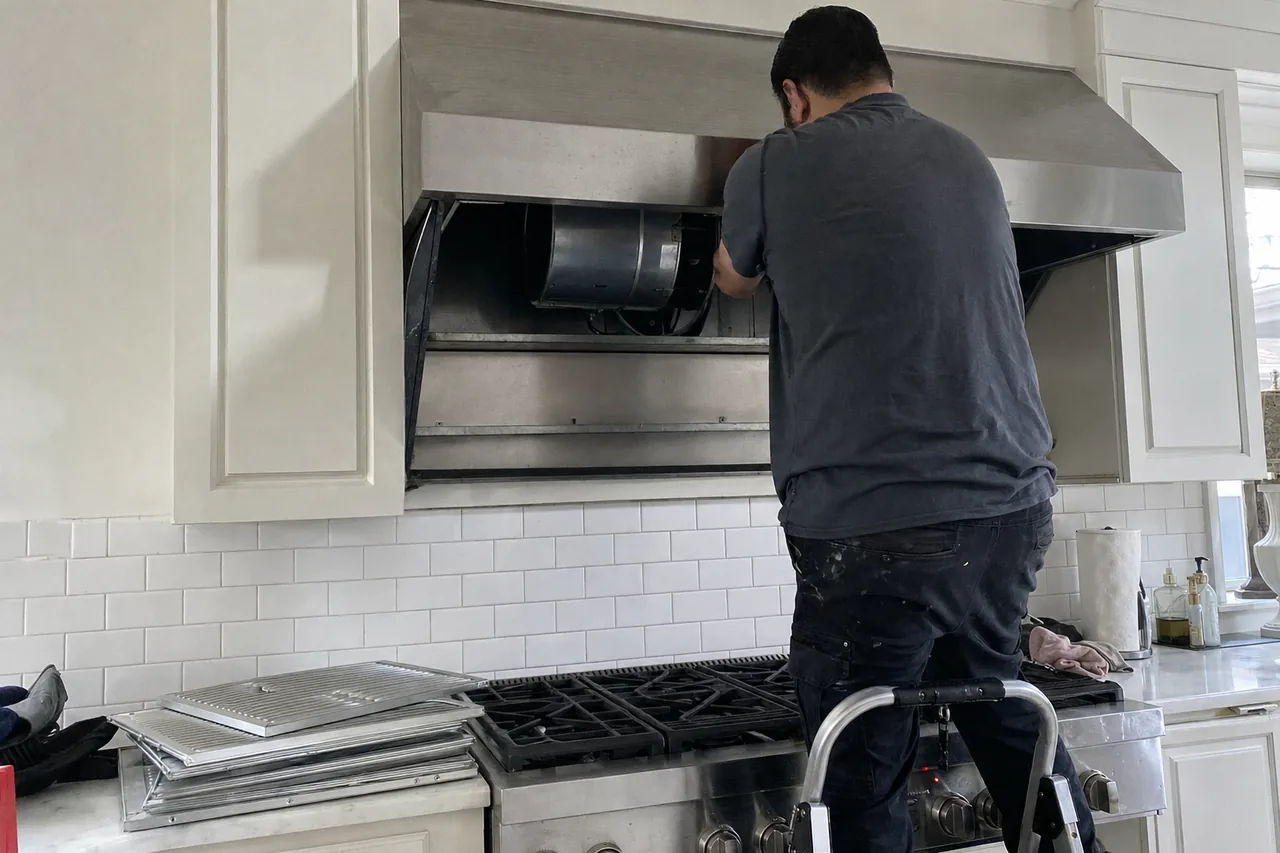
2.6.1 Two complaints, not one
“Loud” and “weak” arrive in the same phone call and they are usually different faults. A hood gets loud when something mechanical changes: bearings, balance, a loose panel, a damper flapping. A hood gets weak when something restricts air: filters, duct, termination, or the house itself refusing to give up the air the blower is trying to move.
We separate them at the start of the visit by measuring, not by listening.
2.6.2 Baffles, and why clean-looking ones still restrict
Wolf hoods use stainless baffle filters. A baffle works by making the air change direction sharply so grease throws out of the stream and drains away, which means its performance depends on the shape of those passages staying as built. Filters that are washed regularly still lose that shape: residue keys into the folded channels where a sponge does not reach, the passages narrow, and capture drops while the visible faces look spotless. Owners are understandably sceptical when a filter they wash every month turns out to be part of the problem.
Two things settle it on site. We measure at the canopy rather than judging by the look of the filter, and we look into the channel rather than at the face. Where a baffle has been distorted by being dropped, or the mesh at its edge has opened up, replacement filters restore more airflow than any amount of scrubbing — and a bent baffle also stops draining properly, which puts grease into the housing behind it.
2.6.3 The duct is half the system
A hood is only as good as the run behind it. We look for the things that turn a capable blower into a weak one: flexible duct used where rigid was specified, elbows stacked close to the outlet, a run reduced in diameter to clear a truss, a roof or wall cap whose damper has stuck part-closed with grease, and screen mesh at the termination that has silted up. In new construction the whole run is inside finished ceiling, so the termination is the part we can inspect and the part that most often turns out to be the restriction.
2.6.4 Makeup air
A high-capacity hood removes more air than a tightly built house can replace on its own. Current residential code requires makeup air above a threshold set by the code in force, and in newer St. Johns County construction that provision is usually already installed — a powered damper or an interlocked supply that opens when the hood runs.
When that damper fails closed the hood does not stop working, it just stops achieving anything: motor at full speed, very little air, doors that pull hard, and in a house with any combustion appliance a genuine safety concern rather than a nuisance. This is one of the few faults where the appliance is innocent and the system around it is not.
2.6.5 Noise, decoded
Rising, bearing-like whine that tracks fan speed: blower bearings.
Rumble or vibration that appears at one speed and clears at others: an out-of-balance wheel, usually grease deposit on one side of the impeller.
Metallic rattle on start and stop only: a damper blade or a loose duct joint.
Hum with no rotation: motor windings, capacitor, or a wheel seized against its housing.
A blower that has been left to run loaded with grease for years fails mechanically in the end, so noise is often the early warning for the repair that follows.
2.6.6 Lights on, blower dead
The lights and the blower are separate loads. Working lights confirm the hood has power and narrows the fault to the blower circuit: the speed control, the motor, its capacitor where fitted, or the wiring between a remote blower and the canopy. Remote and in-line blowers add a length of cable and a set of connections in the attic space, which is where we look first when the canopy tests good.
2.6.7 What the visit involves
Airflow measured at the canopy, filters assessed and not just glanced at, duct and termination inspected as far as access allows, damper and makeup-air interlock exercised, and the blower tested for current draw and bearing condition. Written estimate before any work. Flat diagnostic, credited toward the repair. Wolf equipment only, independent service.
What does this repair cost in Nocatee?
$80 flat to come out and find the fault, credited in full against the repair when you approve it. Beyond that, the work below is what these jobs run to once parts and labour are counted — $80 at the low end, $1,070 at the top of the widest band on this page.
| No. | Work | Completed, parts and labour |
|---|---|---|
| 2.06.6.01 | Flat diagnostic fee | $80 |
| 2.06.6.02 | Control board or touch panel | $460–$1,070 |
| 2.06.6.03 | Convection fan or motor | $260–$690 |
A range, because the firm figure is written down after the diagnosis and not before it. The band a job lands in depends on which part failed, whether the appliance has to come out of the cabinetry to reach it, and what the part costs the week it is ordered. A written estimate is provided before any repair begins. No work starts without your approval.
Questions about wolf hood noisy or weak
- Is a noisy hood the same fault as a weak one?
- No, and they are chased in opposite directions. Weak extraction is usually loaded baffles, a restricted duct run, or a house with nowhere to draw replacement air from. Noise is mechanical: blower bearings, a wheel thrown out of balance by grease, or a damper blade rattling in the transition.
- Will washing the filters fix weak extraction on its own?
- Sometimes, and it is always worth doing first. Baffles look clean long after they have started to restrict, because the grease collects in the folds rather than on the face. If washed baffles change nothing, the restriction lies further along the duct run or the kitchen cannot draw enough makeup air.
Cross-index
2.06.8.1Other repair entries
- 2.02Wolf burner clicks, no flameRange, Rangetop, Cooktop
- 2.07Wolf grill heats unevenlyOutdoor grill
2.06.8.2Reference
- 4.01Storms and boardsPower and storms
- 4.02Access and clearanceInstallation
- 4.03Maintenance calendarMaintenance
- 4.04Power, gas, openingsInstallation
- 4.05Parts and lead timesParts
- 4.06GlossaryGlossary
2.06.8.3Where we are called out
- 3.04Greenleaf Village32081 · Nocatee village
- 3.05Seabrook Village32081 · Nocatee village
- 3.06Crosswater32081 · Nocatee village
What owners said after this repair
4.5 out of 5, from 63 published entries. Each is one visit, in the words of the person who paid for it.
The hood rattled hard whenever it started and settled after a minute. It was a loose mounting bracket that had never been tightened at installation, plus a cracked damper flap. He fixed both in one visit.
Wilhelmina S.
Smoke sat in the room even with the hood on full. He measured airflow at the grille and at the roof cap, found the flexible section above the ceiling half collapsed, and replaced that length with rigid pipe.
Gerald P.
The touch controls on the hood face had gone erratic. He traced it to steam getting behind the panel from the pot filler position below, replaced the control and sealed the joint that was letting it through.
Simone V.