2.07
Wolf outdoor gas grill with cold spots or a dead igniter, in Nocatee
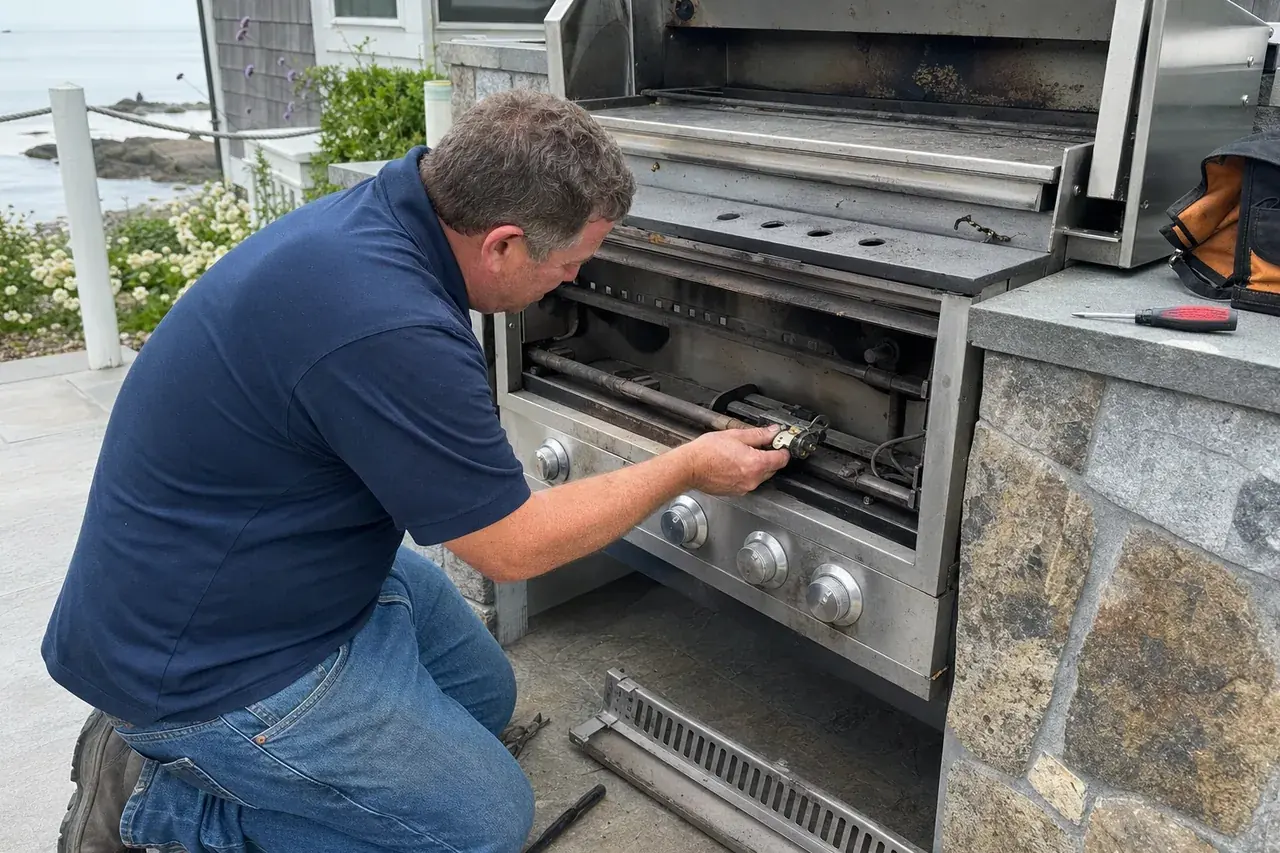
2.7.1 An outdoor appliance has an outdoor life
A built-in grill on a Nocatee lanai spends its year in warm, humid air, takes wind-driven rain from most of the summer afternoons, and is often left unused for weeks at a stretch between gatherings. None of that is true of the range indoors, and it changes the failure list completely. Grill faults here are mostly obstruction and corrosion, and only occasionally electrical.
2.7.2 Venturis and what nests in them
Every gas burner draws combustion air through a venturi tube on its way in. Those tubes are open, warm, sheltered and undisturbed for weeks — which is a good description of the nesting site that mud daubers and other wasps look for. A partially blocked venturi starves that burner of primary air. The flame goes yellow and lazy, soot appears on the underside of the grate, and the burner runs cool while its neighbour runs normally.
This is the single most common cause of one-side-hot we find on a grill that has been idle through a wet stretch, and it is why we open and inspect tubes before touching anything else.
2.7.3 Ports, grease and corrosion
Burner ports block from above as well. Fat drips, carbonises and bridges the ports nearest the drip path, so the flame pattern goes patchy in a line rather than randomly. Where a burner has been left wet through the season, the ports corrode from the inside and open unevenly, which produces the same picture and cannot be cleaned back.
We clear ports mechanically and we replace burners that have thinned. A burner that has corroded through is not a candidate for cleaning, and running it that way puts flame where the design does not expect it.
2.7.4 Fuel supply, and the propane trap
Before condemning any part we confirm the grill is being fed properly.
On piped natural gas the usual restrictions are a partly closed shutoff, a long run shared with another appliance, or a connector kinked when the unit was slid into the island.
On liquid propane there is a specific and very common failure that costs nothing to fix: the excess-flow device in the tank regulator drops into bypass if the cylinder valve is opened quickly with the burner valves open. The grill then lights but never exceeds a weak flame at any setting. The cure is a sequence, not a part — everything off, disconnect, wait, reconnect, open the cylinder slowly, then open the burners. We check this before quoting anything.
Fuel type also has to match the hardware. Natural gas and propane orifices are not interchangeable, and an appliance fed the wrong fuel for its setup will either soot heavily or refuse to make heat.
2.7.5 Ignition
Grill ignition takes more abuse than any other spark system on the property. Electrodes sit low, get washed with grease and rain, and lose their ceramic insulation to thermal shock. A clicking igniter with no light-off is normally a fouled or cracked electrode or a gap that has opened; an igniter that does nothing is normally the module, its battery where fitted, or a corroded ground. The ground connection is worth naming separately, because on an outdoor appliance it corrodes long before anything else in the circuit does.
2.7.6 Infrared and rotisserie sections
Where the appliance includes an infrared burner section, the failure mode is different again: the emitter surface degrades, cracks or clogs, and output falls without any change to the flame you can see through the port. These are assessed by measured surface temperature across the section rather than by eye.
2.7.7 What the visit involves
Every burner removed and inspected, venturis cleared and screened where the design allows, ports cleaned or the burner replaced, supply pressure and fuel type confirmed, ignition circuit tested including its ground, and a full heat-rise test across the grate so the cold spot is measured rather than guessed. Written estimate before any work, and the flat diagnostic is credited toward the repair.
Wolf equipment only.
What does this repair cost in Nocatee?
$80 flat to come out and find the fault, credited in full against the repair when you approve it. Beyond that, the work below is what these jobs run to once parts and labour are counted — $80 at the low end, $660 at the top of the widest band on this page.
| No. | Work | Completed, parts and labour |
|---|---|---|
| 2.07.6.01 | Flat diagnostic fee | $80 |
| 2.07.6.02 | Burner valve or orifice service | $230–$660 |
| 2.07.6.03 | Igniter or spark module replacement | $190–$550 |
A range, because the firm figure is written down after the diagnosis and not before it. The band a job lands in depends on which part failed, whether the appliance has to come out of the cabinetry to reach it, and what the part costs the week it is ordered. A written estimate is provided before any repair begins. No work starts without your approval.
Questions about wolf grill heats unevenly
- Why does one side of the grill run hotter than the other?
- Unequal gas reaching the burner tubes. A venturi partly blocked after an idle spell, ports corroded or filled with grease, or a restriction upstream will starve one tube while the one beside it burns normally. On propane the regulator can also be sitting in bypass and limiting the whole appliance at once.
- What is the propane bypass trap on a built-in grill?
- Opening the cylinder valve quickly while the grill valves are open makes the regulator read the rush of gas as a leak and drop into its safety bypass. Everything lights, nothing gets properly hot, and it reads as a burner fault. Closing everything, waiting, then opening the cylinder slowly resets it.
Cross-index
2.07.8.1Other repair entries
- 2.02Wolf burner clicks, no flameRange, Rangetop, Cooktop
- 2.06Wolf hood noisy or weakVentilation hood
2.07.8.2Reference
- 4.01Storms and boardsPower and storms
- 4.03Maintenance calendarMaintenance
- 4.04Power, gas, openingsInstallation
- 4.05Parts and lead timesParts
2.07.8.3Where we are called out
- 3.02Coastal Oaks32081 · Nocatee village
- 3.06Crosswater32081 · Nocatee village
- 3.07Lakeside32081 · Nocatee village
What owners said after this repair
4.5 out of 5, from 63 published entries. Each is one visit, in the words of the person who paid for it.
The outdoor grill had a cold half and a scorching half. He found one burner tube corroded through underneath where you cannot see it, replaced the pair so they would wear evenly, and reset the shutters.
Rosemary I.
Flames were rolling out from under the front lip. He found the grease tray warped and sitting proud, which was pushing the flame forward, and fitted a new tray plus the two clips that hold it square.
Yvette M.
Two knobs had seized in the salt air and one would not turn at all. He stripped the valve stems, regreased them with the right high temperature grease, and did not push me toward a whole new manifold.
Grover S.