4.01
Storm damage and control boards
Surge and outage damage is rarely instant and rarely total. This entry sets out how it presents, what we check before suspecting a control board, and what is worth fitting in advance.
- Category
- Power and storms
- Equipment
- Range · Rangetop · Cooktop · Wall oven · Convection steam oven · Speed oven · Warming drawer · Ventilation hood · Outdoor grill
4.1.1 Why this is a local subject
North-east Florida records roughly 68 thunderstorm days in an average year, which is a working figure rather than a headline: it means the supply to a house here is disturbed on something like one day in five through the summer. On top of that sit the named events. St. Johns County lost power for days in places after Matthew in 2016 and Irma in 2017, and again after Helene in 2024.
A modern cooking suite is mostly electronics. A wall oven has a control board and usually a relay board. An induction cooktop has an inverter for each coil group. A gas rangetop has a spark module. A hood may have a speed control and a damper interlock. Those parts cost more than the mechanical components around them, and they are the ones a disturbance on the supply reaches first.
4.1.2 Damage is usually partial
The mental model most owners have is that a surge either destroys an appliance or it does not. In practice the common outcome is a component that survives with less margin than it had — a stressed capacitor, a semiconductor junction that has been through more energy than it was designed for, a solder joint that has been heated hard once.
The appliance then works. It works for a week, or a month, or a season, and then it fails on an ordinary evening with clear skies, which is why almost nobody connects the failure with the storm that caused it. If an appliance changed behaviour on the afternoon of a storm and never quite recovered, tell us. It changes what we look at first.
4.1.3 Outages are two events, not one
The loss of supply is the harmless half. The return is where the damage tends to happen: everything in the house that was switched on at the moment of the outage restarts at the same instant, and equipment on a partially restored network can see voltage well away from nominal while that settles.
The practical advice is the boring kind. During a prolonged outage, switch large appliances off at the breaker rather than leaving them to come back by themselves, and bring them back one at a time once the supply has been stable for a while. It costs nothing and it removes the worst moment from the equation.
4.1.4 What we check, in order
Supply first, always. Both legs of a 240-volt feed measured under load rather than at rest, the breaker itself — breakers age, and one that has tripped repeatedly can trip early or hold badly — and the connections in the box behind the appliance, which loosen with thermal cycling and read as an intermittent fault long before they read as a dead one.
Protective devices next. Thermal cutouts and fuses exist to open, and an open one is a symptom rather than a diagnosis; the question is always what made it open, and refitting one without answering that is how the same repair happens twice.
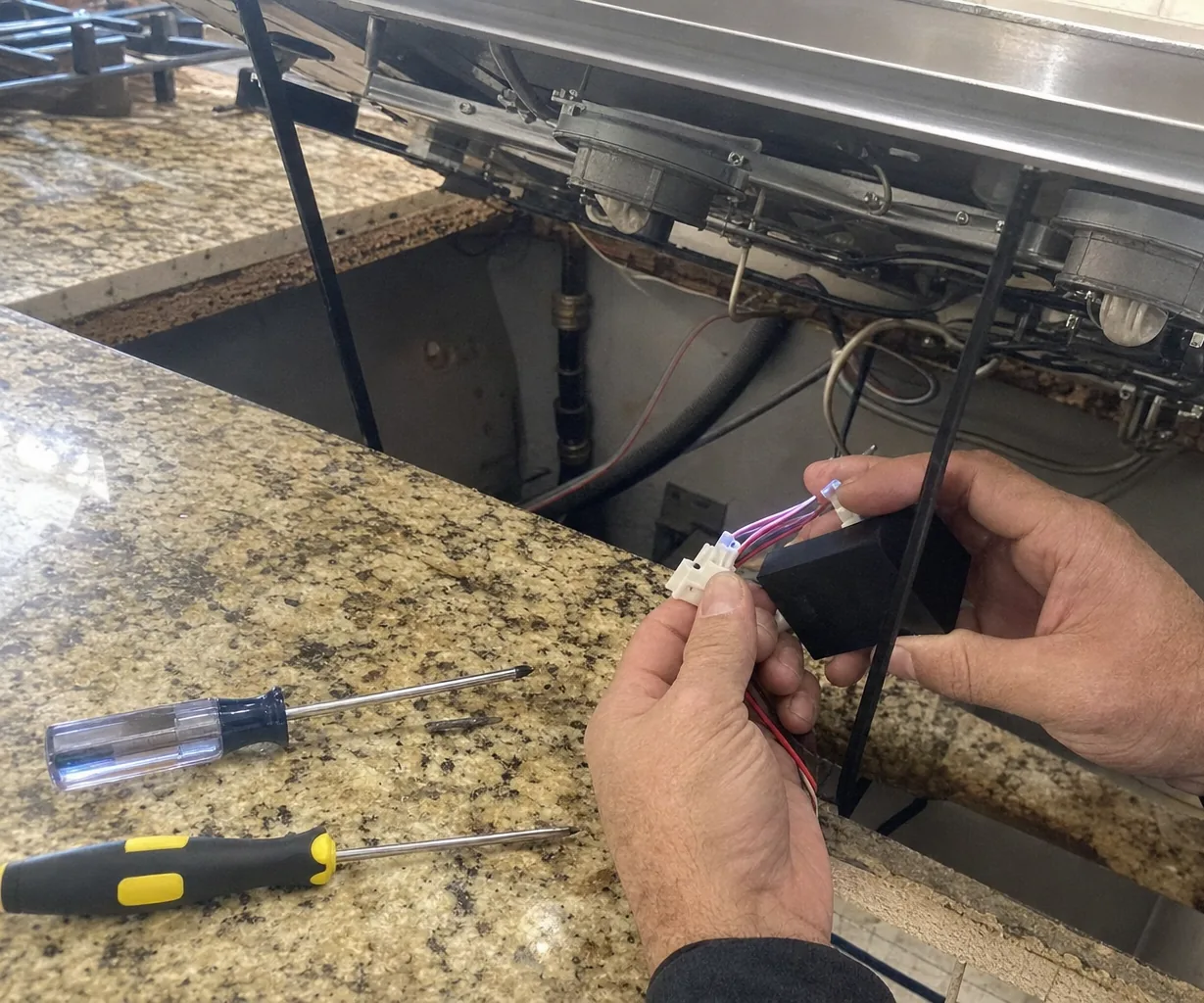
Then the low-voltage side: harnesses, connectors and the ribbon between a display and its board, all of which suffer from heat and vibration and none of which cost what a board costs.
The control board is last on the list. It is the most expensive part in most of these appliances and, in the calls we take, the least often the actual answer.
4.1.5 Protection is an electrician’s job
Whole-house surge protection is fitted at the panel and it is the only measure that covers a hard-wired appliance, since a built-in oven has no plug to put a strip on. We do not sell or install it. We mention it because we see the consequences of not having it every summer, and because the arithmetic is not close: the protection costs less than one control board for one appliance.
Point-of-use protection still helps for anything that does plug in, and it has a service life — a device that has taken a large event has done its job and should be replaced rather than trusted indefinitely.
4.1.6 When to call the manufacturer instead
If the appliance is still inside the manufacturer’s warranty, take the fault to the manufacturer’s own service channel first. That work is theirs to do and it costs you nothing.
Where a homeowner’s insurance claim is involved, ask what documentation the insurer wants before any parts are changed. A written diagnostic that records what was measured is usually acceptable; an appliance already stripped and repaired is a harder claim to make.
What does the repair behind this note cost?
$80 flat to come out and find the fault, credited in full against the repair when you approve it. Beyond that, the work below is what these jobs run to once parts and labour are counted — $80 at the low end, $1,070 at the top of the widest band on this page.
| No. | Work | Completed, parts and labour |
|---|---|---|
| 4.01.6.01 | Flat diagnostic fee | $80 |
| 4.01.6.02 | Oven thermostat or temperature sensor | $180–$520 |
| 4.01.6.03 | Burner valve or orifice service | $230–$660 |
| 4.01.6.04 | Igniter or spark module replacement | $190–$550 |
| 4.01.6.05 | Control board or touch panel | $460–$1,070 |
A range, because the firm figure is written down after the diagnosis and not before it. The band a job lands in depends on which part failed, whether the appliance has to come out of the cabinetry to reach it, and what the part costs the week it is ordered. A written estimate is provided before any repair begins. No work starts without your approval.
Questions this note answers
- Why does surge damage show up weeks after the storm?
- Because it is usually partial. A board that survives an event can come through with a stressed capacitor or a weakened junction — still working, but with less margin than it had. It fails properly on an ordinary evening with no storm in sight, which is why the owner rarely connects the two events.
- Should I have surge protection fitted?
- It is worth having, and it is an electrician's job rather than ours. Protection belongs at the panel and on the circuit, fitted by somebody licensed to work there. We can tell you what a power event did to the appliance end of it, but we do not install protection ourselves.
Cross-index
4.01.8.1Repair entries
- 2.01Wolf oven not heating, or driftingWall oven, Range
- 2.02Wolf burner clicks, no flameRange, Rangetop, Cooktop
- 2.03Wolf induction drops outCooktop, Range
- 2.04Wolf steam oven, no steamConvection steam oven
- 2.05Wolf panel dark, no responseWall oven, Speed oven, Warming drawer
- 2.06Wolf hood noisy or weakVentilation hood
4.01.8.2Other reference entries
- 4.03Maintenance calendarMaintenance
- 4.04Power, gas, openingsInstallation
- 4.05Parts and lead timesParts
- 4.07Self-cleanMaintenance