2.03
Wolf induction cooktop that cuts out mid-cook, in Nocatee and its villages
2.3.1 Induction fails differently
An induction element is a coil, an inverter and a set of thermistors under a glass-ceramic surface. It has no flame to watch and no element to glow, so every fault presents the same way from the kitchen side: it stops. Sorting out which of four unrelated causes did the stopping is most of the visit.
2.3.2 The pan, first
Induction heats the pan, not the surface, and it only heats ferrous pans. A magnet that will not hold on the base of the pan means the cooktop cannot drive it. That much most owners already know. The subtler versions:
A pan with a sandwich base where the ferrous disc is smaller than the coil will work, but the cooktop reads it as a small load and may cut back power. A base that has warped — and thin bases warp after enough thermal cycling — loses contact in the centre, so detection flickers on and off as the metal moves. A pan smaller than the minimum diameter for that element will be ignored entirely. We ask people to bring out the pan that was on the cooktop when it failed, because the fault often walks in with it.
2.3.3 Heat has to leave
Under the glass, the electronics are cooled by a fan pulling air through the cabinet. When the inverter reaches its limit the cooktop protects itself by dropping power or shutting the element down. This is the single most common “intermittent” complaint we see in Nocatee kitchens, and it is almost always an installation issue rather than a failed part.
The things that block the path: a drawer packed with linens directly under the cooktop, a warming drawer or oven fitted below without the specified separation, a fitted island panel that closed off the return air the installer had planned for, or a filter surface packed with dust after a few years. In new construction the appliance is set once and never looked at again, so a cabinet alteration made later is rarely connected by the owner to a cooktop that started misbehaving two months afterwards.
2.3.4 Supply, and the missing leg
A full-size induction cooktop is a 240-volt appliance fed by two hot legs. Lose one leg — a failed breaker, a loose lug, a burnt terminal at the junction box — and the appliance does not go dead. Some elements keep working and others do nothing, which reads like a random partial failure and sends people straight to the assumption that the board is bad.
We measure it. Both legs to neutral, both legs to each other, at the appliance rather than at the panel, because the fault is usually in the last three feet.
2.3.5 Storms and the control
St. Johns County gets roughly 68 thunderstorm days a year. Cooking electronics are the part of a kitchen that a nearby strike or a utility switching event reaches first, and induction has more of that electronics than anything else on the counter. A cooktop that changed behaviour on the afternoon of a storm and never came back is a different case from one that has degraded over months, and we treat them differently: the first is a survey of every board and the supply that feeds them, the second is usually a single component that has aged out.
2.3.6 Glass and touch controls
The surface is structural. A chip at the edge, a crack from a dropped lid or a pan set down hard changes how the touch controls read, because the sensors work through the same glass. Controls that respond to a wet finger but not a dry one, or that fire the wrong pad, point at the surface and its ribbon connection rather than at the main board.
2.3.7 What the visit involves
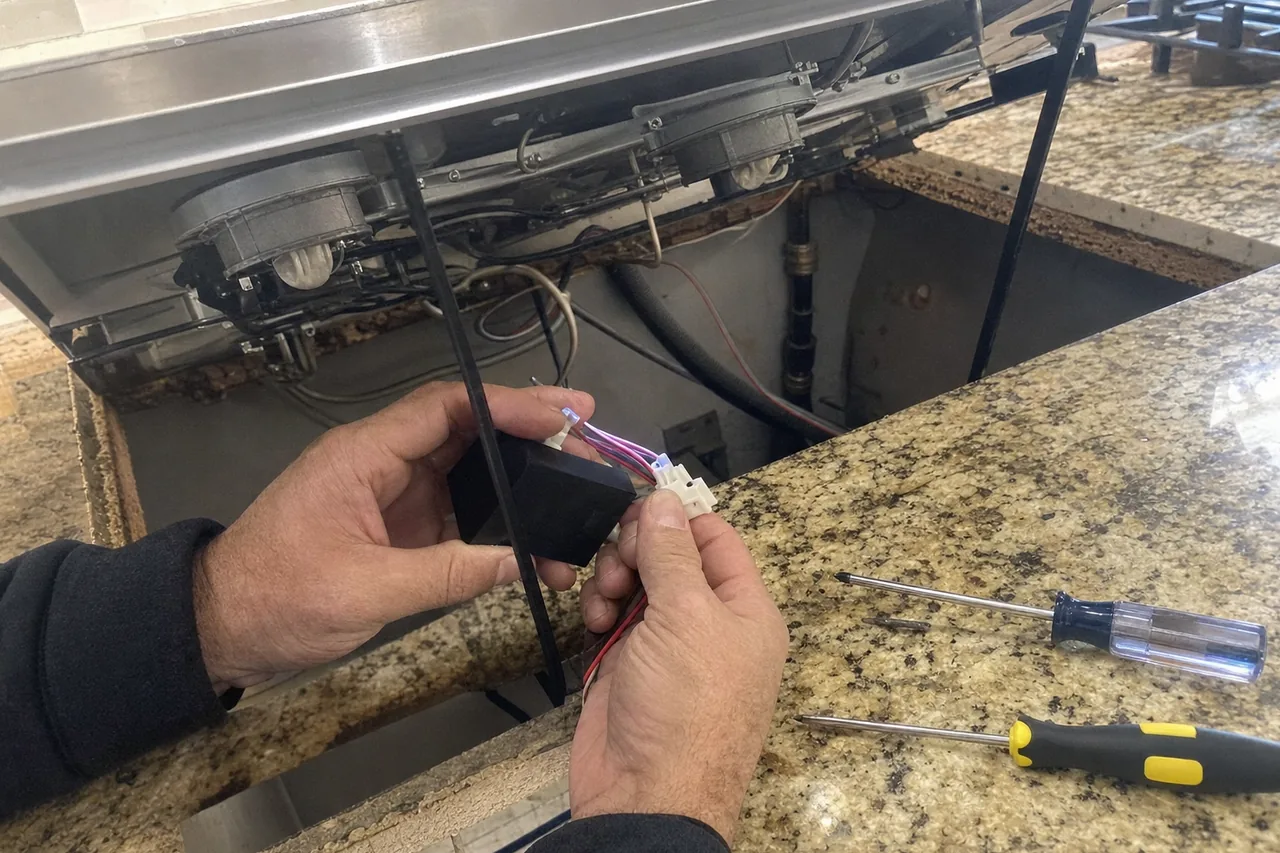
We verify cookware against the element, measure supply at the appliance, pull the unit forward far enough to inspect the cooling path and the cabinet around it, read the fault history the control retains, and load-test each element with a known-good pan and a thermal record. If the fix is a cabinet change rather than a part, we tell you that and charge you the diagnostic, not a board.
Written estimate before any work. Flat diagnostic, credited toward the repair. Wolf equipment only, independent service.
What does this repair cost in Nocatee?
$80 flat to come out and find the fault, credited in full against the repair when you approve it. Beyond that, the work below is what these jobs run to once parts and labour are counted — $80 at the low end, $1,070 at the top of the widest band on this page.
| No. | Work | Completed, parts and labour |
|---|---|---|
| 2.03.6.01 | Flat diagnostic fee | $80 |
| 2.03.6.02 | Burner valve or orifice service | $230–$660 |
| 2.03.6.03 | Igniter or spark module replacement | $190–$550 |
| 2.03.6.04 | Control board or touch panel | $460–$1,070 |
| 2.03.6.05 | Oven thermostat or temperature sensor | $180–$520 |
A range, because the firm figure is written down after the diagnosis and not before it. The band a job lands in depends on which part failed, whether the appliance has to come out of the cabinetry to reach it, and what the part costs the week it is ordered. A written estimate is provided before any repair begins. No work starts without your approval.
Questions about wolf induction drops out
- Why does an induction zone shut itself off partway through cooking?
- Four causes, in the order we find them: cookware the coil cannot see, an obstructed cooling path letting the electronics under the glass run hot, the loss of one leg of the 240-volt supply, and last a control fault. Boards are the least common of the four and the dearest, so they are checked last.
- How do I know whether the pan is the problem?
- Hold a magnet against the base. If it does not grip firmly, the coil cannot couple to it, and a thin or warped base that lifts away from the glass behaves the same way. Try that pan on another zone: if it drops out everywhere, the cookware is the fault and nothing needs repairing.
Cross-index
2.03.8.1Other repair entries
- 2.01Wolf oven not heating, or driftingWall oven, Range
- 2.02Wolf burner clicks, no flameRange, Rangetop, Cooktop
- 2.05Wolf panel dark, no responseWall oven, Speed oven, Warming drawer
2.03.8.2Reference
- 4.01Storms and boardsPower and storms
- 4.02Access and clearanceInstallation
- 4.03Maintenance calendarMaintenance
- 4.04Power, gas, openingsInstallation
- 4.05Parts and lead timesParts
- 4.06GlossaryGlossary
2.03.8.3Where we are called out
- 3.03Del Webb Nocatee32081 · Nocatee village
- 3.05Seabrook Village32081 · Nocatee village
- 3.07Lakeside32081 · Nocatee village
What owners said after this repair
4.5 out of 5, from 63 published entries. Each is one visit, in the words of the person who paid for it.
One zone stopped seeing my pans while the rest were fine. He checked the coil, found a broken joint on the sensing lead and repaired it. He also showed me how to tell whether a new pan will work before buying.
Marion E.
The whole top shut down and would not come back after a storm. He found the surge had taken the low voltage supply on the main board, replaced that stage, and talked through protecting the circuit properly.
Franklin Y.
The left front zone kept dropping out under a heavy pan. He measured both supply legs at the appliance, found one sitting low, and traced it to a loose connection in the junction box behind the unit.
Marguerite P.