4.03
A service year in a Nocatee kitchen
What to do, and roughly when, for a Nocatee kitchen: the habits that prevent faults, the twice-yearly checks that catch drift early, storm-season preparation and the seasonal grill service.
- Category
- Maintenance
- Equipment
- Range · Rangetop · Cooktop · Wall oven · Convection steam oven · Warming drawer · Ventilation hood · Outdoor grill
4.3.1 Why a local calendar exists at all
Maintenance schedules in appliance manuals are written for an average house in an average climate, and this is not one. The year here has a long humid summer with roughly 68 thunderstorm days in it, outdoor cooking equipment that stands idle for weeks between uses, and — in a town whose housing dates from 2007 onward — a great many kitchens whose appliances went in together and are therefore due for the same attention at the same time.
What follows is the order we would work through if the kitchen were ours. None of it needs a technician.
4.3.2 Every cycle, without thinking about it
Wipe spills off a rangetop before the next use rather than after. A boil-over that is wiped while it is still soft is a cloth; the same spill left to bake into a burner port is a crust that will not wipe off and eventually a burner that lights unevenly.
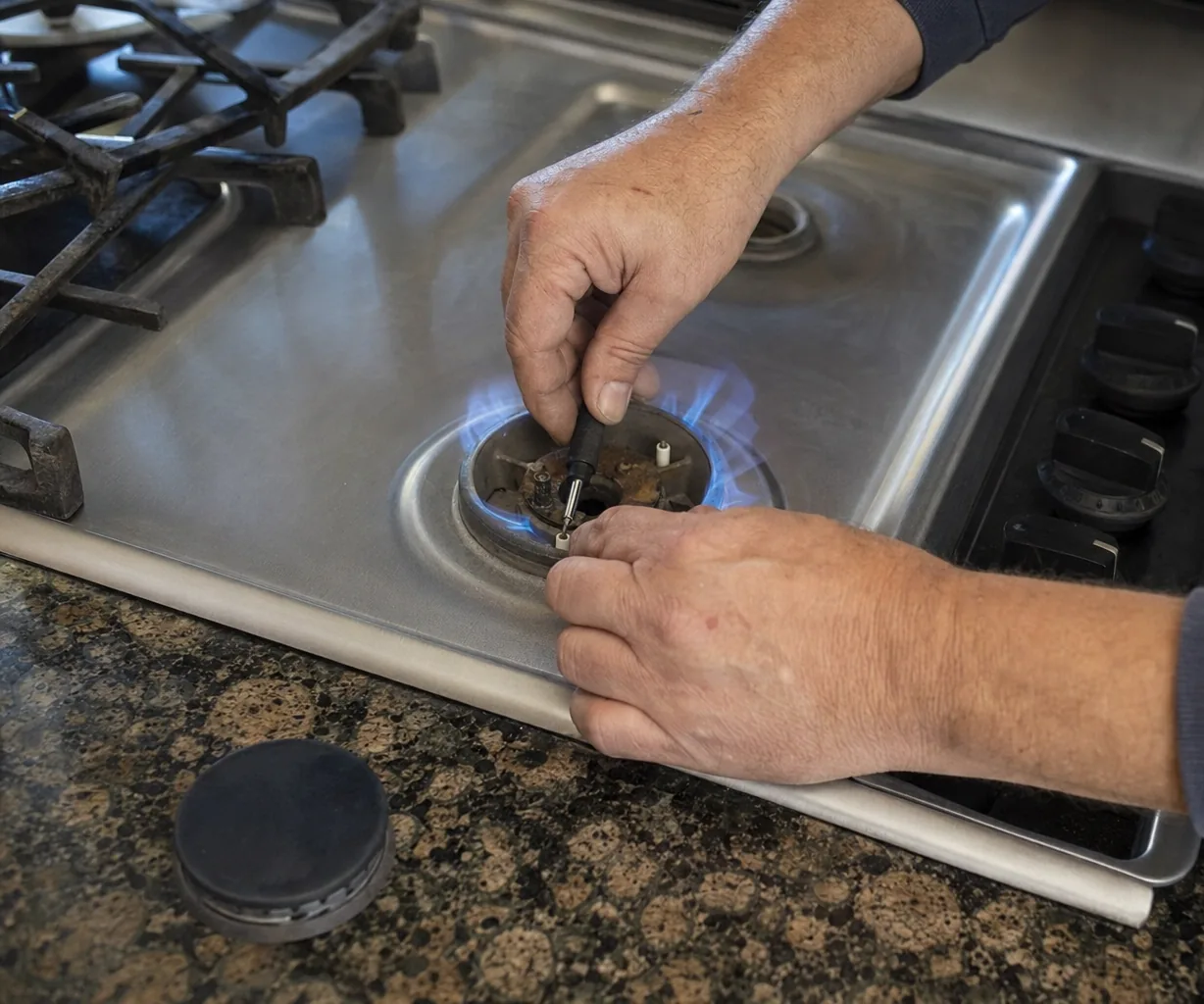
Let burner caps and grates cool, then dry them rather than leaving rinse water standing on them. Put caps back square, with the ignition port facing the electrode — a cap replaced a few degrees out of position is the single most common reason a burner sparks and will not light.
4.3.3 Monthly
Wash the hood baffles, and dry them before refitting. Look into the channels rather than at the faces: a baffle works by making air turn sharply, so a distorted or dented one both restricts airflow and stops draining properly, and it will look perfectly clean while doing it.
Check that the drawer beneath a cooktop still closes without pressing against anything, and that nothing has been stored where an appliance takes its cooling air. Blocked clearance is a fault cause, not a tidiness issue.
4.3.4 When the appliance asks
Run the steam oven’s descale cycle the day the prompt appears rather than at the end of a busy week. The prompt is the appliance reporting its own use, and deposit that is cleared while it is soft comes away completely, while deposit left to harden and layer does not come away at all.
Use the manufacturer’s descaling agent. Vinegar is the usual advice online and it attacks seals and aluminium components inside these circuits — it is the most common way a recoverable machine becomes a parts order.
4.3.5 Before storm season
Late spring is the sensible time to look at surge protection, because cooking electronics are what a disturbance on the supply reaches first and a control board is the most expensive part in most of these appliances. Whole-house protection is an electrician’s job, not ours, and we mention it only because we see the results of not having it every summer.
If an appliance behaves oddly after a storm — a display that has changed, a setting that will not hold, an element that runs when it should not — treat it as a fault rather than a glitch. Surge damage is often partial, and partial damage gets worse.
4.3.6 Twice a year
Look at the door seal on every oven in the house. A gasket that has hardened or a hinge that has lost tension leaks enough heat to imitate almost every temperature complaint in this index, and it is the cheapest thing on the list to put right.
Run every burner through its full range, including the lowest simmer. Faults show up at the extremes long before they show up in normal cooking.
Run the warming drawer. Drawers fail silently and the failure is usually discovered at the worst possible moment, on a day when the kitchen is full.
While you are at it, photograph the data plate on each appliance and keep the picture. Everything is ordered against the model and serial number, and retrieving it later means moving the appliance.
4.3.7 The grill, seasonally and after any idle spell
Before the first use after weeks of standing, take the burners out and look through the venturi tubes. Wasps nest in them during idle spells, and a blocked tube starves the burner of primary air — yellow flame, soot under the grate, one cold side.
Clear ports, check the electrode and its ground, and confirm the fuel supply is open and the connector is not kinked. On propane, open the cylinder valve slowly with the burner valves closed, or the regulator’s excess-flow device drops into bypass and the grill will not make heat at any setting.
4.3.8 What is worth calling us for
Anything that has changed and stayed changed. Appliances drift, and drift is measurable. A diagnostic that finds a hardened gasket or a blocked venturi costs the same as one that finds a failed board, and it is a better outcome for everyone.
What does the repair behind this note cost?
$80 flat to come out and find the fault, credited in full against the repair when you approve it. Beyond that, the work below is what these jobs run to once parts and labour are counted — $80 at the low end, $1,070 at the top of the widest band on this page.
| No. | Work | Completed, parts and labour |
|---|---|---|
| 4.03.6.01 | Flat diagnostic fee | $80 |
| 4.03.6.02 | Oven thermostat or temperature sensor | $180–$520 |
| 4.03.6.03 | Burner valve or orifice service | $230–$660 |
| 4.03.6.04 | Igniter or spark module replacement | $190–$550 |
| 4.03.6.05 | Control board or touch panel | $460–$1,070 |
A range, because the firm figure is written down after the diagnosis and not before it. The band a job lands in depends on which part failed, whether the appliance has to come out of the cabinetry to reach it, and what the part costs the week it is ordered. A written estimate is provided before any repair begins. No work starts without your approval.
Questions this note answers
- What is actually worth doing yourself between visits?
- Keep burner caps seated square with their ports clear, wash hood baffles on a schedule rather than when they finally look dirty, and descale a steam oven when the appliance asks rather than when it stops. Those three habits prevent more calls than everything else on this calendar put together.
- When in the year should an outdoor grill be serviced?
- Before the season it will be used in, and again after any long idle spell. An unused burner tube is exactly where a nest ends up, and that is the commonest reason a grill comes back heating unevenly. Storm-season preparation belongs to the indoor equipment, ahead of summer.
Cross-index
4.03.8.1Repair entries
- 2.01Wolf oven not heating, or driftingWall oven, Range
- 2.02Wolf burner clicks, no flameRange, Rangetop, Cooktop
- 2.03Wolf induction drops outCooktop, Range
- 2.04Wolf steam oven, no steamConvection steam oven
- 2.05Wolf panel dark, no responseWall oven, Speed oven, Warming drawer
- 2.06Wolf hood noisy or weakVentilation hood
4.03.8.2Other reference entries
- 4.01Storms and boardsPower and storms
- 4.02Access and clearanceInstallation
- 4.07Self-cleanMaintenance
- 4.08Range careMaintenance