4.08
Wolf range maintenance: a care routine for burners, grates, griddle and oven
A care routine for a Wolf gas or dual fuel range, with intervals: grates, burner caps and igniters, griddle and charbroiler, control panel and knobs, hood filters, the oven door gasket and the clean cycle.
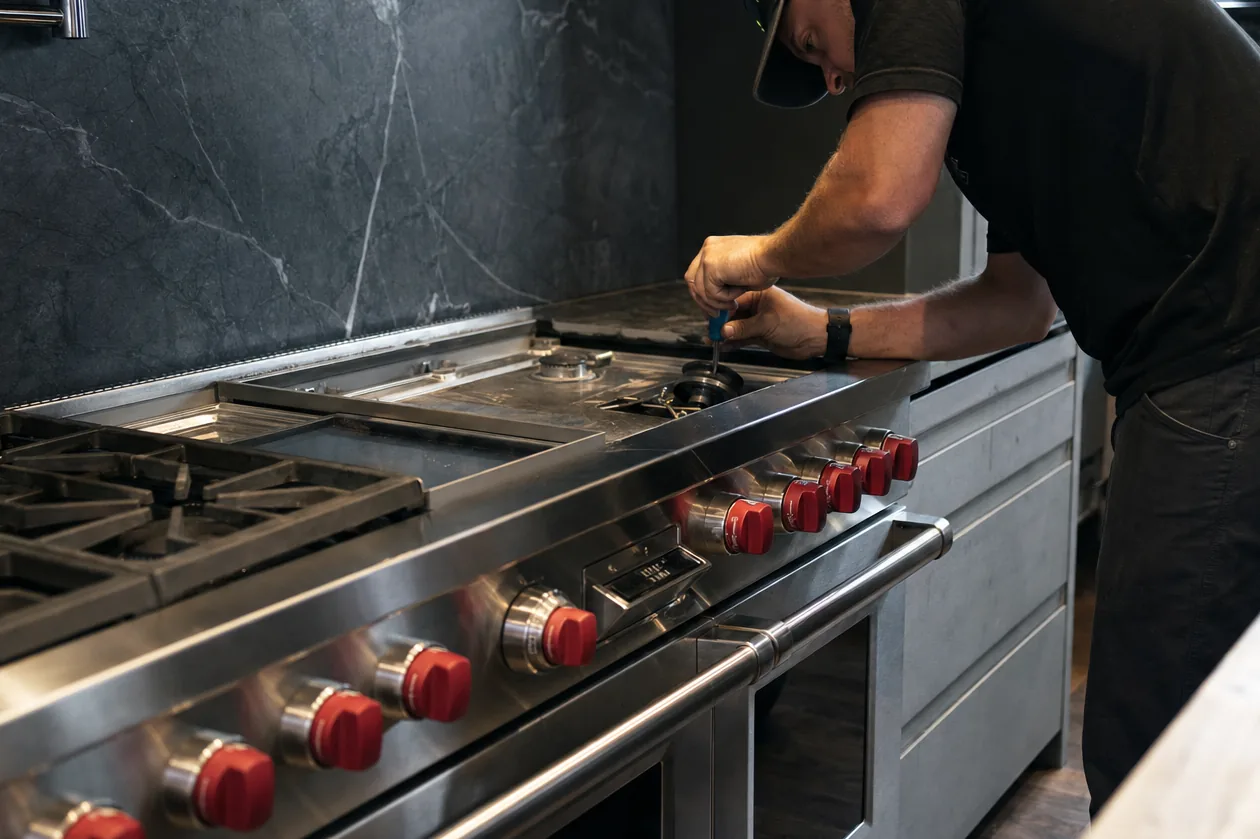
- Category
- Maintenance
- Equipment
- Range · Rangetop · Cooktop · Ventilation hood
Wolf range maintenance comes down to a short routine repeated often: wipe spills once the cooktop cools, wash the grates and burner caps every week or two, brush crusted igniters with a soft toothbrush each month, and clear grease from the oven before it bakes on. Hot water, mild dish soap, a soft cloth, a non-scratch pad and an old toothbrush cover nearly all of it. Two habits matter most: the knobs get only a damp cloth, and the oven door gasket is never cleaned, because Wolf tells owners to leave it untouched.
4.8.1 A care calendar you can actually keep
Spread across the month, no single session takes long:
- After each meal: once it cools, wipe the stainless top and burner bases, and empty the griddle’s grease tray if you used it.
- Every week or two: wash the grates and caps, then wipe the knobs and front panel.
- Monthly: brush the igniters, check that every cap sits level, and wash the hood’s grease filters.
- When the oven looks dirty: prep the cavity and run the clean cycle, then inspect the door seal and porcelain while everything is cool.
Daily searing or frying moves each step up; cooking twice a week lets you stretch them.
4.8.2 Grates, burner caps and igniters
Grates are heavy, so carry them to the sink instead of soaking them in a full basin; Wolf’s cooktop guidance says not to immerse them. Scrub each one under hot running water with mild soap, and spread baking soda paste on the stubborn spots. Rinse, dry thoroughly and skip steel wool, which scratches the finish.
Burner caps lift off by hand. Wash and dry them, then set each one flat and centered on its base; a cap that rocks gives a lopsided flame and can stop the burner from catching. Clear a plugged port with a straight pin, not a wooden toothpick that might snap off inside.
The igniter is the small ceramic point beside each burner. If food has crusted on it, scrub it gently with a soft-bristle toothbrush and let it dry before lighting. Owner care ends there: a cracked, broken or loose igniter needs a technician. A burner may click after a boil-over until the moisture dries; if it keeps clicking once dry, see the entry on a burner that clicks but will not light. Igniter or spark module replacement typically runs $190–$550, with the firm figure after the $80 diagnostic.
4.8.3 Griddle and charbroiler
The charbroiler handles part of its own cleanup: after grilling, leave it burning for 10 minutes so leftover food chars off. Once the grate has cooled completely, drape it with towels soaked in hot water to loosen the residue, then scrub.
Wipe the griddle after every use and strip it now and then. Mix 1/2 cup (120 ml) of warm water with 1 teaspoon (5 ml) of griddle cleaner, work it over the plate, and push the loosened residue into the grease tray with a scraper. When the plate is dry, oil it lightly.
A dual fuel range’s infrared griddle is seasoned in a set order: heat it at 350°F (175°C) for 30 minutes, spread peanut or vegetable oil once it has cooled slightly, then heat it at 350°F again until the oil begins to smoke.
4.8.4 Control panel, knobs and the hood
On a dual fuel range, lock the electronic oven panel before wiping it by holding Lock for 3 seconds. Spray degreaser onto the cloth rather than the panel, so liquid stays out of the seams. Knobs get a damp cloth only. Wipe stainless along its grain with mild soap.
The hood deserves a monthly visit too. Greasy filters choke airflow and leave the kitchen smokier, so wash them in hot soapy water and let them dry before refitting.
4.8.5 Oven door, porcelain and the clean cycle
Leave the door gasket alone. Wolf warns that rubbing or shifting it can spoil the seal, so clean the glass and frame around it and stop there. A torn or flattened gasket is a repair: door seal work typically falls in the $200–$670 range, confirmed after diagnosis.
Fine lines, small chips or a cloudy patch in the porcelain are usually cosmetic. The enamel expands and contracts with each heat cycle, self-clean especially, and the marks stand out more in a colored cavity.
Before pressing Clean, shave baked-on spills off with a razor blade and wash the cavity with soap and water, since leftover chemical cleaner can etch porcelain at high heat. Afterward, wipe out the ash with a damp cloth. Timings, smoke and the door lock are covered under self-clean problems.
If your gas range came with a newly built Nocatee home and has never been used, burn it in first: clean the oven, bake at 500°F (260°C) for 30 minutes, broil for another 30 minutes with the hood running, then let it cool with the door shut.
4.8.6 When cleaning stops helping
Book a visit when a clean, dry burner still clicks without lighting, flames stay yellow or lift off the ports with the caps seated, the oven misses its set temperature, or the door no longer closes snugly. If you smell gas, turn the burners off, leave the house and call your gas utility from outside. A visit starts with the $80 diagnostic, so you know which part is at fault before deciding on a repair.
What does the repair behind this note cost?
$80 flat to come out and find the fault, credited in full against the repair when you approve it. Beyond that, the work below is what these jobs run to once parts and labour are counted — $80 at the low end, $1,070 at the top of the widest band on this page.
| No. | Work | Completed, parts and labour |
|---|---|---|
| 4.08.6.01 | Flat diagnostic fee | $80 |
| 4.08.6.02 | Burner valve or orifice service | $230–$660 |
| 4.08.6.03 | Igniter or spark module replacement | $190–$550 |
| 4.08.6.04 | Control board or touch panel | $460–$1,070 |
| 4.08.6.05 | Oven thermostat or temperature sensor | $180–$520 |
A range, because the firm figure is written down after the diagnosis and not before it. The band a job lands in depends on which part failed, whether the appliance has to come out of the cabinetry to reach it, and what the part costs the week it is ordered. A written estimate is provided before any repair begins. No work starts without your approval.
Questions this note answers
- How do I clean Wolf range grates without damaging them?
- Scrub them by hand under hot running water with a little mild soap, and use a baking soda paste with a non-scratch pad where food has burned on. Wolf's cooktop guidance says grates should not be immersed, so skip the long soak in a full basin. Dry each grate completely before setting it back over the burners.
- How often does a Wolf range need maintenance?
- A quick wipe after each use, a grate and cap wash every week or two, and a monthly look at the igniters and hood filters cover most gas ranges. The oven needs attention whenever soil builds up inside it. If you use the griddle or charbroiler, clean that surface after every cooking session rather than letting residue pile up.
- What should I avoid when cleaning a Wolf range?
- Avoid steel wool and gritty powders on the grates and stainless, spray aimed straight at the electronic control panel, and any cleaning of the oven door gasket. Knobs should only get a damp cloth. Chemical oven cleaner left behind in the cavity can etch the porcelain once the clean cycle heats up, so wash it out first.
Cross-index
4.08.8.1Repair entries
- 2.01Wolf oven not heating, or driftingWall oven, Range
- 2.02Wolf burner clicks, no flameRange, Rangetop, Cooktop
- 2.03Wolf induction drops outCooktop, Range
- 2.06Wolf hood noisy or weakVentilation hood
4.08.8.2Other reference entries
- 4.03Maintenance calendarMaintenance
- 4.05Parts and lead timesParts
- 4.07Self-cleanMaintenance